Chasing an Impossible Dream | Dr. Eiman Jahangir

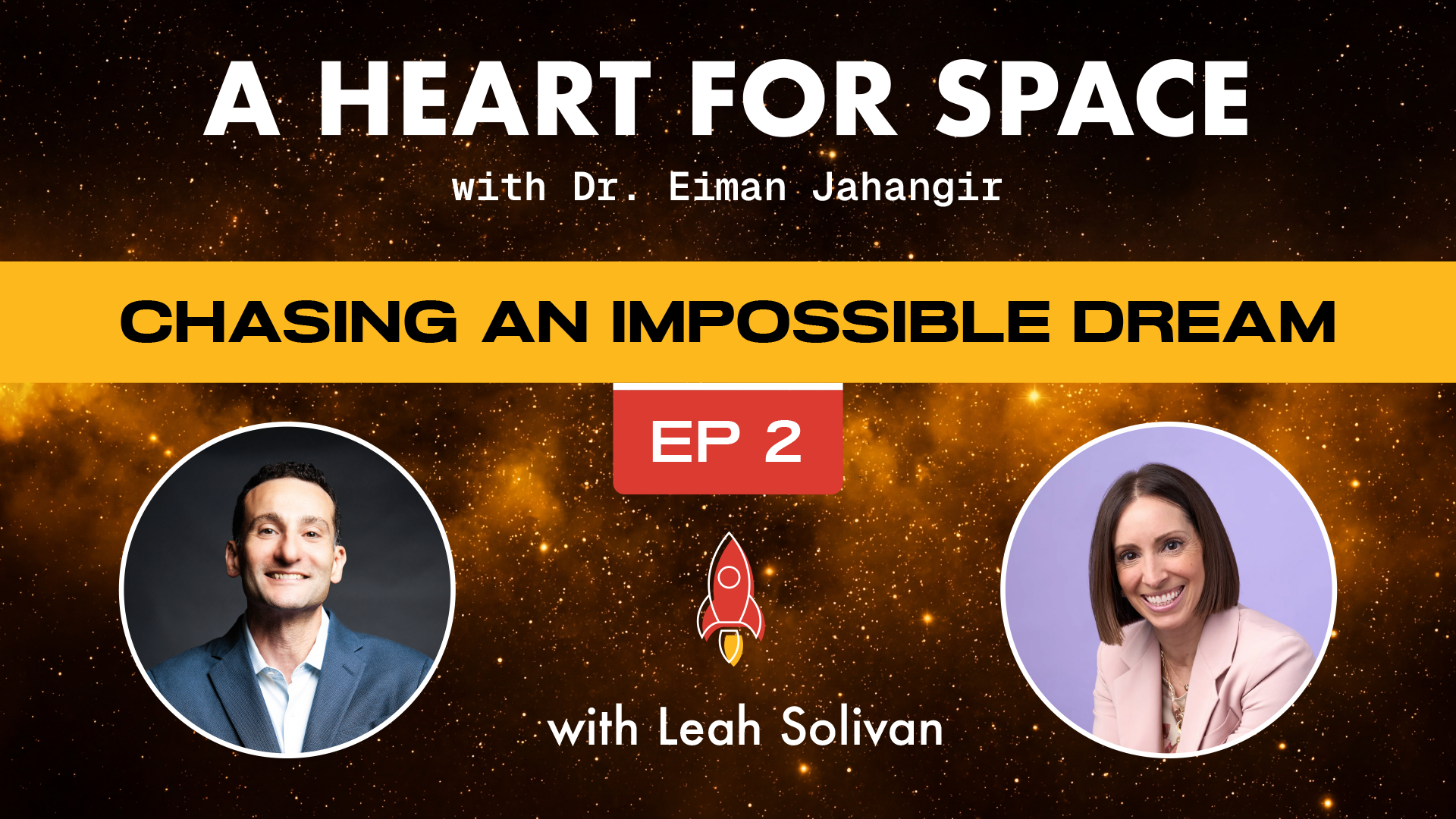


In today's episode of A Heart for Space, Dr. Eiman Jahangir is joined by his sister-in-law Leah Solivan as they engage in a deeply personal conversation about the experiences, relationships, and ambitions that have shaped Eiman's extraordinary journey.
Moving beyond headlines and accomplishments, Eiman reflects on his upbringing as the child of immigrants and the early influences that drew him toward medicine, as well as his lifelong fascination with space that continued to pull at him even while building a demanding career in cardiology.
The conversation explores the realities of life as a physician—from the emotional weight of patient care and the growing pressures contributing to burnout, to the deeply human moments that continue to make the work meaningful.
Leah and Eiman then dive into the perseverance required to pursue a dream with no guaranteed path forward. After more than twenty years of trying to reach space, Eiman reflects on the emotional experience of finally launching aboard Blue Origin’s New Shepard with his family watching nearby—a moment that represented not only the significance of the achievement, but the years of persistence, uncertainty, and unwavering belief that made it possible.
(00:19) Welcome to A Heart for Space
(01:54) Who Is Eiman Jahangir?
(03:13) Medicine, Family Expectations, and the Search for Stability
(06:05) A Day in the Life of a Cardiologist
(07:39) AI, Healthcare Systems, and the Future of Medicine
(09:40) Patient Stories and the Human Side of Medicine
(12:06) When Space Became a Real Goal
(15:48) Launch Day and the People Waiting on Earth
(17:45) Liftoff, Emotion, and Finally Reaching Space
(22:55) Writing A Heart for Space
(25:00) What Eiman Wants Readers to Take Away
Discover more about Dr. Eiman Jahangir, and preorder your own copy of A Heart for Space, now at https://aheartforspace.com/
19:00 - Welcome to A Heart for Space
01:54:00 - Who Is Eiman Jahangir?
03:13:00 - Medicine, Family Expectations, and the Search for Stability
06:05:00 - A Day in the Life of a Cardiologist
07:39:00 - AI, Healthcare Systems, and the Future of Medicine
09:40:00 - Patient Stories and the Human Side of Medicine
12:06:00 - When Space Became a Real Goal
15:48:00 - Launch Day and the People Waiting on Earth
17:45:00 - Liftoff, Emotion, and Finally Reaching Space
22:55:00 - Writing A Heart for Space
25:00:00 - What Eiman Wants Readers to Take Away
who wants to really read my story like I don't know it's I don't have enough hubris to think people are so interested in my story so then I was like how could I make this useful and I thought you know what I could take what I do in my talks which is talking about chasing your dreams the eight steps and build a book around that welcome to a heart for space I'm your host Dr. Emo and Joe Hunger join me as we uncover what it takes to reach beyond the limits of what we think is possible and turn the biggest dreams into tangible reality thank you today Leah for joining me on my podcast this is actually the second time we're talking for this podcast though I think your episode's gonna come after this and on this one I thought maybe you could ask me some questions let's turn the table which seems weird but we're gonna do it I want to turn the tables you've just been peppering me with questions that's right no I'm excited to be here I'm excited to interview you a little bit Eman because I think that your audience needs to know more about you and who you are and I think it's so great that you're bringing all these people on dinner view as well but you have an incredible story so let's dive into it I will also say if you want to hear more about my story go to breaking precedent oh yes Leah's podcast where she interviewed me both pre-flight and post-flight yes and I think like a a further down reflection so she's got all the all the emotions I have a series of three interviews with Eman yeah and I'm actually gonna re-release them this week oh perfect yeah it's gonna be really really fun but yeah let's let's dive in because you've got some incredible things to share so kind of before we get into all of the amazing impressive stuff that you have done let's just start very basic like who is Eman Jahangir as a person how how would the closest people to you describe you yeah this is good because this is what I ask people in my podcast you know I think people would say that I am funny hopefully kind and maybe a little impatient I think that's accurate I think I think that's three things those are accurate for you yeah yeah that's so good and were you always like that as a kid as well like throughout your entire life I think it was funny and kind I don't know when the impatience it I don't know if that happened as I got older or as I had children or if I always had some level of like attention deficit hyperdip I don't know I've never been diagnosed with ADHD but I do wonder if my like need to move factors into my need for everything else to move at the same speed which is not fair and it is if you're gonna ask me which one thing I am constantly working on it is being more patient with the systems in healthcare because sometimes they do not move fast I mean we could have a whole episode about that and we should but I honestly don't know how you do it I get so impatient when I'm on hold just waiting to make a doctor's appointment it's crazy yeah um what was was medicine always the plan for you or did you ever explore other paths so I wanted to grow up and be obviously an astronaut but also I always liked Indiana Jones and I thought what I went to college I would do anthropology as a major that that was gonna be awesome but from a young age I had also been kind of I wouldn't say steered but my father steered me to be a doctor and I kind of knew that's what I want to do and so to make that happen I had to do a lot of pre-med brex so I gave up on my anthropology dreams at a young age so yeah I think medicine was that thing that I was always trying to achieve from a young age because being an immigrant in the US seeing what my parents had to go through giving up a very comfortable middle-class life to coming here and having to rebuild everything it was all about stability so there was no idea I know you've done entrepreneurship you kind of broke that precedent in your family as we talked about in our podcast but really it was just like find a stable job be able to support your family and then give your kids so the next generation has that ability to take those risks yeah yeah yeah know that totally totally resonates what about the focus on cardiology like how did that happen or what drew you to that particular field yeah I mean I've told this story before but when I was eight years old my grandfather came over for a bypass surgery and had a stroke so all of a sudden this guy who was a professor of pharmacist he couldn't speak and it was scary I didn't really know what a stroke was but I that was my first experience with cardiology and so I knew I was interested in as I was getting in medical school you kind of hang out with people in the fields that you think you might want to do so if you want to be an auntie you're gonna go hang out with the antique crew you want to do orthopedics and I just really got along with the people in cardiology they were all like pretty level-headed people there's a lot of engineering that goes in cardiology so I just enjoyed both like the medical aspect of it of like oh you have a heart attack and I can fix it and things being less ambiguous and also the people in the field and I think those two things really pushed me to to decide to do that it's all about the people and who you surround yourself with I mean really it is and it's this also goes back to exposure because if you have exposure to different types of people then maybe you would end up in a career that would be different I always say like I definitely could have made different choices in high school and college that would have gotten me more likely accepted as an ass astronaut but I didn't have those people around me to guide me right so I didn't know about the internship that you could take in Houston or that in college you could go do an internship at Johnson Space Center yeah no clue yeah yeah totally so interesting so paint as a picture like what is your typical day look like as a cardiologist oh man I mean I think both our days wakes up with kids so once we get through the family piece I get to work most days I mean right now life is good so it's like most days they're at eight sometimes they're at seven a.m. and I'll either be in clinics seeing patients you know one after another some new patients some return patients and then on other days I'll be reading ultrasounds doing stress tests doing procedures kind of like shocking people like clear you ever see that on TV like shock them yeah it's fun it's still fun it's still fun every time you stop the heart you're like okay is it gonna start up oh my god that's crazy there used to be a game show I forget what it's called but it was like in the late 70s early 80s and they'd hit this button and they'd be like no whammy's no whammy's oh yeah I always in my head I'm like hit the button I'm like no whammy's no you want to make sure that the everything goes smooth right yeah so that part and then seeing patients in the hospital so it's a lot of patient-centered care and then I'm doing some teaching and a lot of administrative work these days so really glamorous as they say but this is you know it's funny because everyone wants to be a doctor like those people want to be a doctor it's like you're growing up you know like I want to be a doctor I'll see patients and then like you get there and this is what you do every day and potentially for 30 40 years and it wears a lot of us down I mean you see it burn out is a very real thing and it's not the patient piece like humans are fine it's all of the other system pieces you know the insurance companies the administrative work the the paperwork and so it's interesting to see how it's gonna evolve in the next 10 years with AI there's already apps that you can use that will you just speak to the patient and does the whole note for you so you don't even have to type anymore if you don't want yeah I was in to see my doctor just yesterday getting over this little cold and you're like oh do you mind if I start my scribe that's right and yeah and then it sent me notes afterwards I was like that's pretty cool yeah so it's gonna be a good tool yeah it's like AI is really gonna transform this industry and and hopefully you know break down a lot of these systems that are just not aligned with patients and patient care well there's there's a group called doctronic I'm not a financial investor anything in them but they're basically an AI generated doctor and then it gets you through a point where it gives you some diagnosis and it says you can you know talk to a live doctor for X amount of dollars or a television for X but they are they were given permission to prescribe refills of any medication in Utah first time so you don't have to see a doctor it you know it goes through like the pharmacy great idea they had to get insurance they had to get state approval but as of yesterday the board of medical licensing in Utah I think since a letter to the state and I think are talking about suing them so there's like these are those legal precedences that have to be figured out like yeah AI could probably do that pretty well the risk of harm is pretty low so I'm just refilling your blood pressure medicine but there's gonna be fights because the old guard and the new guard and yeah it's interesting and incentives are not aligned the incentives are not aligned yeah yeah so it'll be an exciting time I'm excited to see what are you talking a little bit about patient care and seeing patients and like can you share maybe one or two patient stories that have stuck with you through the years yeah so I mean I've had a lot of patient stories but I think the ones that the ones that stick with me are the like how hard life is and how unfair it can be so for one instance there's this one woman I knew who I was seeing who was diagnosed with cancer while pregnant so here young woman all of a sudden finds out she's pregnant super exciting right trying to get pregnant for a while and then gets diagnosed with cancer and now can't have treatment for that cancer until her kids born so delays treatment of her care for I don't know months waiting for this kid to be born and then the kids born and now has to get treatment and you know how that first period where you have a newborn is in your breastfeeding and your body's been through a lot just from the pray and you know and there's so many stories like this is just like there's there's nothing she did these were just the cards she was dealt so it's like how do you deal with that how do you persevere with that and then on the flip side you have patients who come to you and they're in terrible shape from like you know things have happened maybe they have the congestive heart failure or they have surgery they've had a heart attack and you see them change their lifestyle improve things get healthier but yeah I mean I think the the one thing is being a physician does is it let you kind of get a wide swath of human humankind different socioeconomic statuses different life choices different you know cards dealt and so it makes me always appreciative when we're healthy when we're you know living our lives fully comfortably because people people have it hard out there yeah and and I think that's when I was working for Blue Origin last year there were days where I was sitting around and like we were doing cool stuff and like rocket stuff and space stuff but I was like you know I kind of miss seeing people and hearing their stories and trying to help them out yeah yeah it's amazing perspective and puts everything in perspective absolutely and your health is so important so let's dive into space a little bit you mentioned Blue Origin when did space first become a real goal free and not just a dream yeah I mean I think the this goes to something you said when we were talking the muscle of conviction which I love that line that's a great term I was 24 we'd gone to Kennedy Space Center I was a fourth year med student I was about to become a doctor and then I realized this is something I want to do like really do so that was that first step into the unknown I was like well how do you become an astronaut well let's look it up get some information and then just having the goal to to put my name in there like I belonged and somehow making it to the finals which was unexpected so yeah I mean I think that was it and then unfortunately when you make it to the finals then you're like oh I really do belong here and then you maybe if I hadn't gotten passed round one it would have been a dream that I that I let go but if you have a little bit of success sometimes that's enough to really push you to keep going yeah what did what did your family think during this time you talked about your you know family of immigrants and stability and the importance of stability and your parents wanting you to go into medicine what did they actually think when you decided to make space an actual goal well my brother reminds me of this story he says you know I had applied not thinking anything I was 24 no by time I applied I was 28 it was 2008 and then I got the first application back sent in the secondary application then I got an interview and I still hadn't told my parents so my brother knew Amber knew your your sister and then I got an interview to come back as a finalist and my brothers like dude you kind of need to tell mom and dad so I think I was so afraid of just like what they would say or how they would get into my head because yeah in their mind at this point I was in cardiology fellowship living in Nashville like this was the dream their dream I was back yeah yeah and I was going to be a cardiologist very stable career helping people and so I didn't tell them until I was a had a finalist interview in 2009 and then they were like are you crazy what do you mean why would you do this this is insane yeah which is pretty funny but that's that's but that's the reality of it because in their mind one it's unsafe right like one out of 64 shuttle what your odds of death in the space shuttle is one out of 64 this is pretty high rate of failure yeah and so and then also like you're gonna go be a government worker which is stable but it's not the same as being a physician so yeah it took a while okay so the it took a while did they come around what like what has been the sort of I want to really go to the launch day as well yeah it was 29th of 2024 because your parents were there they were there yeah it's a stir was there yep yeah the kids there too the kids were there yep and my brother was there they it's questionable if they came around it's funny because in 2013 when I became a finalist they also thought it was crazy and then Jasmine Mulbelly who's a Iranian woman she wasn't Iranian born she was born in Germany but she's like military I think helicopter pilot NASA astronaut she finally flew to space and spent six months on the space station two three years ago and they were so proud here's this Iranian woman and my brother's like dude that could have been your son where where were you a few years back so yeah come around to like getting picked and I knew I was gonna go space my parents came to our house and I sat down and I told them and they were both like okay yeah that makes sense like we figured eventually you'd go okay but then the morning of yeah they were a mess and I get it like you're gonna see this person sit on top of a rocket who you love you understand that the rocket could blow up and that this person is gonna go to space yeah and something could go wrong there and I love you know in talking to Jeff Bezos I think the thing that he said was very interesting he said he said to me you don't appreciate how much people love you until you're about to strap yourself to a rocket because when he went up he went up with his brother Mark and he had his you know his parents there his extended family and he's like it's harder on the people that aren't going with you because they're the ones like watching so yeah so I told my brother I'm like please take care of mom and dad I'm out because you really had to focus right and be mentally present for this mission right yeah and you you definitely want to not be worrying about everyone on earth right also particularly a suborbital launch it's not as long and I made videos before like for everyone in case something went wrong and in all the videos I said to Amber to my parents my brother I'm like listen you couldn't don't think you could have said something that would have made me not go like I was going so this isn't on you this on me I'm like sorry it kind of sucks that I'm not here now yeah but you are here so yeah but let's talk about the liftoff in that moment where you know the rocket fires up and you get launched into space so just drop this through it so I was sitting there and waiting for a hold you know commonly in any launch there's a hold which means that the flight controllers pause the countdown so that they can either go back and fix an error or if there's an error that pops up they can account for it is this mission critical or not so you almost always see a hold and then there is a certain level where like the systems take over it's automated and there's no turning back so as soon as we got to the point where the systems took over which for new shepherd is at T minus two minutes I think for the new Glenn it's closer to T minus five then you're going like it's really hard to stop that thing because all the automated systems kicking so then I'm waiting and it's like then you hear the 1098 and I'm like they can't take me off this rocket so I will say I I cried on the way up I was very emotional was it happy tears happy tears but if I had been a better like social media influencer I would have definitely not cried and taken better photos or something but you know I didn't have that experience yeah you see some of these people they're professionals and their photos coming down are pretty impressive but yeah I was super emotional because this had been 20 years of actively trying with no guarantee ever right like there's still been less than 800 people have gone to space and so to at least know that I did that you know I still want to go orbital I would love to do like a sling shot around the moon one day I think they are whole society needed that Artemis yes mission and that crew was exactly the right crew and yes I told Amber I was like in a different timeline I was on that mission because all of the astronauts were picked up in either oh nine or 13 which were the two years I was down to like 50 so it was fun to watch them they were perfect they were perfect for the they did such an exciting and it is exciting to see you know what's happened space and technology and you know Mars is next and all the there's so much there's so much ahead of us so there's so much ahead of us we live in exciting times which is why in the next 20 years I will get to orbit and maybe a sling shot around the moon I believe it I don't doubt you for a second so once you got up there you did have a few minutes of weightlessness above the earth what did you do in those few minutes I mean I was surprised at how easily it was to move around because I opened my seatbelt and thought I'd have to push but you just kind of float up and very quickly I realized that one of my crewmates was having trouble getting out of their seat mainly because they said I'm having trouble getting my my seatbelts undone and it yeah I mean I think it was could have been quite stressful so I went into like dad doctor mode I turned right around and asked them like what's going on they said okay I can't get the straps open and I said okay can I try like because I didn't want to just jump in they said absolutely and I will say luckily we were able to unstrap and get the person out and kind of so they had a great experience but it was interesting because I mean that probably took up 30 seconds of the four to five minutes of floating around but like it goes to show you that like you are who you are wherever you are and I was both dad and doctor are like very much parts of who I am so I'm always thinking about how I can help people and if there's an emergent situation I'm probably going to be one of the first to jump in which in this case I was and so yeah I did that and then I obviously looked out the window I did plank um when everyone but I waited for everyone to sit in their seat before you were a master of planking I have the best photos of you planking I mean I was disappointed this weekend there was a Arnold Schwarzenegger like pop up in California that I knew was happening but I couldn't get to and they had a planking competition and I was like I would have been on I would have been all over it yeah maybe not the place of competition people moving escalators playing that's all I got it all I have to say okay that was your 30th birthday Amber's 30th birthday that was a while ago it was a long time ago don't worry I let my daughter thinks I'm five years old based on her school work that she's in home yesterday so she's the cutest the cutest okay so you planked in space that was a priority I love that priority yes yes anything else you helped this person yeah yeah and then you know I I flipped upside down looked out the window and just wanted more I remember seeing your little heart floater yes I did have a heart yeah yeah yeah so you know it's like cardiologist so I got a crocheted heart yeah a heart for space which is the name of this podcast in my book and so I did let it float I have video of it somewhere but just yeah I should pull that out video pull it out put it on put it on the grams it was so yeah okay well let's let's talk about the book next um so you do have a book coming out so on top of everything else that you're doing uh you are also an author or what what may you decide to write the book a couple of things I mean initially after my fight I was like oh I'd like to share my story you know I tried this for 20 years and and I was doing that in person talking to students uh which I get a lot of joy of like the the kids in Memphis this morning were awesome and but then I was like who wants to really read my story like I don't know it's I don't have enough hubris to think people are so interested in my story so then I was like how can I make this useful and I thought you know what I could take what I do in my talks which is talking about chasing your dreams the eight steps and build a book around that I was like okay now we've got an idea like a little bit of my story a little bit about like a how to and I was like but really I feel like it needs more and I was fortunate because I was reading another book it was by one of the shark tank guys um what's his name the guy who started Fubu you know like the clothing brand when we're young yeah yes and he had a he has a really good good book it's called starting from broke and it's really about like building your brand and not spending a lot of money until you're growing and he had interviews with people throughout the whole book which was really great I was like I wonder if I could get some interviews then I'll have something so I reach out to my network you know and send some cool emails reach out to some friends and before I know it I had not only my story not only like the steps and the how to part but also interviews with eight astronauts which I think is much more interesting right than a memoir for me at least to be able to include all those pieces Jared Isaacman the current NASA administrators in it which is pretty cool my mentor the second cardiologist based Drew Gaffney's in it and a lot of other really cool people so I feel fortunate because once again it's like you know I had the ability to reach out to these people and they said yes that's awesome that is awesome what's the one thing you really want readers to walk away feeling or thinking after they read the book I want people to know that like they are in a lot of ways what's holding them back they can do people can do things that they don't think they can and so they should just go try and if it works great and if it doesn't great because at least you tried you tried chasing that dream and and so we shouldn't be the ones self limiting ourselves we should we should really give it if there's something inside you that's like speaking to you then get out there and try to get it done I love that so cardiologist Arthur astronaut is is there a common thread you're connecting all of it or did life just take some wild turns long the way I mean I think hyperactivity like we said earlier I gotta say like when we were kids that like diagnosing ADHD was not a thing did not exist yeah didn't exist so it's weird yeah whatever but I was able to sit down and like study so I didn't have that whatever I have wasn't that student yeah I was always studious um I mean I think the common thread is like being willing to work hard and like sacrifice some of the like parts of your life to achieve the dreams that you have right for medicine that's very obvious right like didn't go out some nights in college didn't during medical school had to spend nights studying residency I mean well into my 30s I was spending 30 hours in the hospital like yeah I gave up on holidays I gave up on weekends I gave up on hobbies I gave up on income gave up on sleep gave up on sleep habits because I'm still my sleep habits are messed up yeah for for space it it's harder I mean I think the last 20 years it I've pursued things that I thought would make me more like enticing tenasa it didn't seem like work I think for for space stuff it's just being okay with the nose because NASA said no to me five times I had six other things I applied for say no before the 12th one hit so yeah just being okay with that and then the other piece I think goes back to having if you feel something calling you just go do it which is yeah I really felt like writing a book and so I made it I said okay I'm gonna give myself eight weeks I'm gonna write a chapter a week um it's amazing and it's not gonna be great but I'm gonna get it out there and then I can fix it once it's out there yeah yeah it's it's absolutely incredible so for people that don't typically see themselves in these kinds of stories what do you think your journey says about what's possible to them you could be the one that that makes it so someone else can see it right so I was a boys and girls club member when I was little um so there might be kids in the boys and girls club that don't think these things are possible yeah uh I was you know an Iranian immigrant kid with a weird name in the south mm-hmm I don't think anyone knew what I was gonna do I think you just have to have faith in yourself and and not let other people define you yeah how much of that sort of outsider mindset do you believe gave you an edge versus holding you back like how do you think about that oh yeah I mean I think being an outsider can be useful because it might allow you to see things in a different light uh for things that have well-defined roots you know if you're gonna be a doctor or if you're gonna follow a path down the business line maybe not as an entrepreneur but like I want to be a banker and then I want to be an investment I think being an insider is probably more helpful because then you have uh a network that's gonna teach you and carry you I do think it's important if I do think it's important to find the people that are gonna carry you and help you and lift you and mentor you in being an insider sometimes helps right so maybe if I had had some more opportunities uh in connections because I was not an outsider who had been helpful but I think for some industries um being an outsider is better probably an entrepreneurship because you're looking for things that no one's seen before yeah well I just think your story is so incredible too because you did take this non-traditional path to get to space and you know it's like not it's so unique and maybe you wouldn't have done that either right if if you had been more an insider and so it's like wow being able to share this story with people I think is so powerful because it is so unique and it's it's non-traditional which is great no you're right maybe I would have said okay well NASA doesn't want me I'm out that's that yeah right nothing else is good enough for yeah right yeah what's something you learned from going to space that you bring back into your work as a doctor I try to be I mean I feel like I always had a good sense of humanity you know going back just from being a physician but I try to also be more patient this goes back to the in-patients piece with everyone because um I mean if you do see earth from above and particularly the pictures the Artemis crew just sent back I mean you realize how how we are an oasis sitting in a black black desert and this is it yeah we are and humans have only been on this planet for a very small portion of that history so we need to try to be kind with each other and forgiving and understanding because maybe we live a hundred years in the entire history of the earth that's not a long time so it's not great to use that time to be mean to each other or we're trying to take from each other yeah I thought the Artemis crew they just did such an amazing job reflecting on humanity and the good in humanity and it was I mean it was just so inspiring to watch like you said what I think we all needed that yeah I mean and just the crew selection was they all brought something very specific and very special and you know whether it was Victor Glover with his faith or you know Carol who had died that they named a crater after which I mean having someone with twin daughters at home without them I mean just all of it the stories of the crew were incredible and then I just saw something pop up on Instagram today one of the naval officers who rescued them you know they go in and they get them out of ship in the water he had brought a night phone and he was like video recording it and then one of the astronauts took it and and set a statement to his son he's like hey your dad just told me you built the Artemis Lego set like he's here helping get I mean the guy just got back from the moon and here he is wow making a video for the guy who's I mean it's just they're just an incredible crew yeah yeah super cool yeah so so what's next for you Elon what are you working on what are you thinking about now I think we are going to get the book out hopefully go around talk to some people and try to inspire them but I think maybe next I might have another book in me but it might be medical okay all right so I think I'm thinking maybe a space medicine book oh okay very cool very cool I would read it and sign me up I just got to figure out how to write that and do all the research so it might take a little longer but it'll come out okay so so one last question when you look back at everything this incredible journey the medicine the flight the writing what are you most proud of I guess I'm most proud of two things one it's obviously going to be the kids in the family right because they're going to be the legacy beyond all of this but two it's that the one one thing doesn't define me or you or anyone and two that I'm still on a journey to keep being challenged right it's not like oh I'm now a cardiologist I could just coast right or oh I went to the space that one time I'm done it's how do we how do I keep challenging myself how do I keep pushing um yeah and I think that's that's the thing to stay challenged awesome all right well thank you you man this is so much thank you for taking yeah thank you for taking this time Leo thank you for listening to a heart for space if you enjoyed this conversation be sure to follow the show so you never miss an episode and consider leaving us a review to let us know your thoughts for more on my work in the pursuit of ambitious goals visit a heart for space dot com and look out for my upcoming book our heart for space until next time I'm Dr. Emanja hungier and remember sometimes the only obstacle to achieving an impossible dream is the courage to keep going