Seeing Earth from Orbit | Chris Sembroski

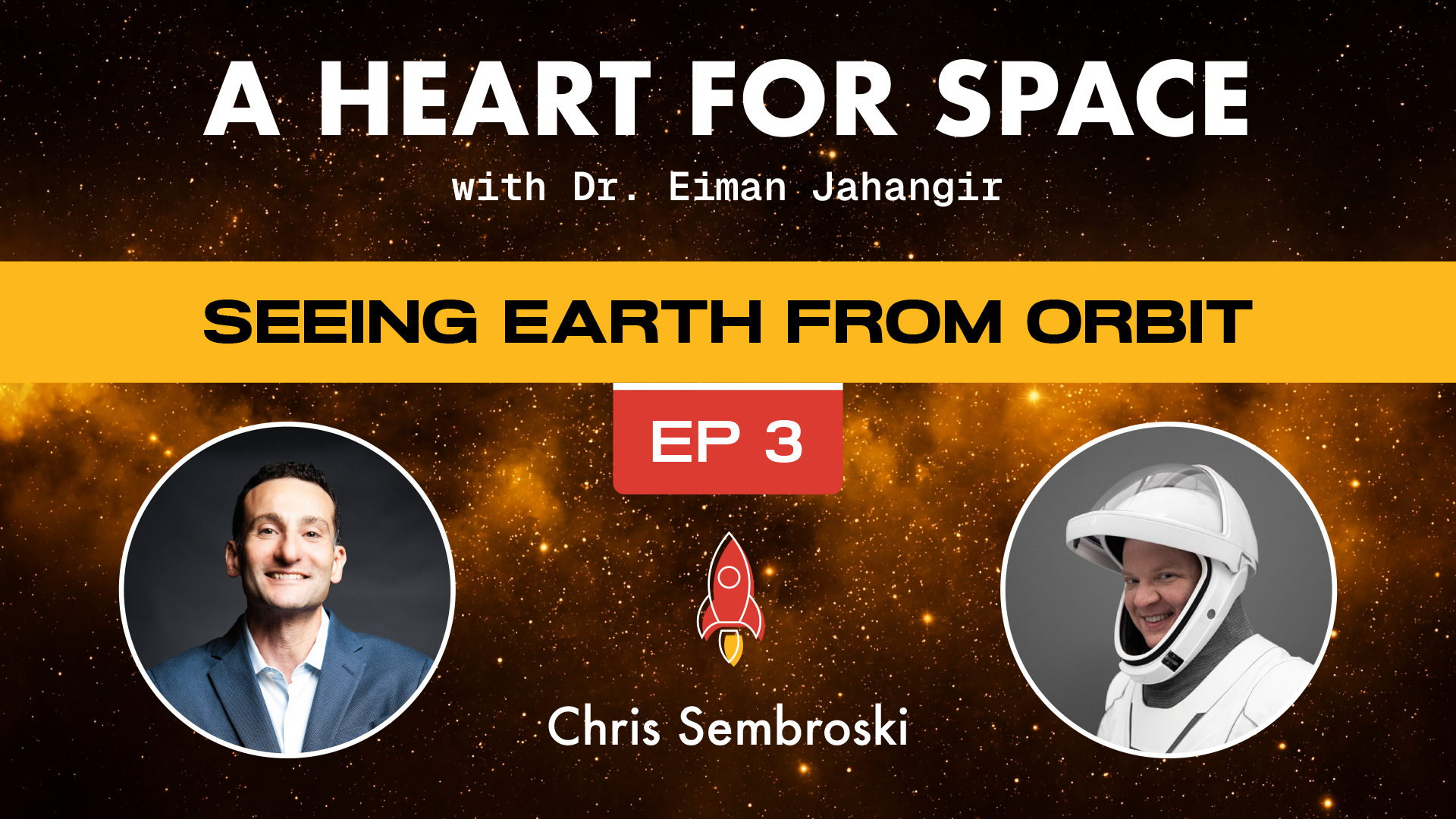


In this episode of A Heart for Space, Dr. Eiman Jahangir sits down with Inspiration4 astronaut Chris Sembroski to discuss the life-changing experience of seeing Earth from space, the unexpected journey that led him there, and the deeper perspective he returned home with.
Chris shares how a childhood fascination with rockets and astronomy eventually led him through the U.S. Air Force, aerospace engineering, Blue Origin, and ultimately into orbit aboard Inspiration4—the first all-civilian mission to space. Along the way, he reflects on the importance of curiosity, community, and staying open to unexpected opportunities.
Their discussion explores the remarkable story behind Chris’s journey to space, and how a donation to St. Jude Children’s Research Hospital unexpectedly became the catalyst for a phone call that would change his life forever. Chris also opens up about the deeper impact of spaceflight and the profound sense of connection that came from viewing Earth from orbit. From the Overview Effect to the responsibility of caring for one another on our shared planet, he shares how the experience reshaped his understanding of humanity.
To learn more about Chris visit https://www.chrissembroski.com
(00:18) Welcome to A Heart for Space
(01:35) Life, Family, and Building Tow Trucks for Space
(02:25) Chris’s Aerospace Career and Work on New Glenn
(05:10) Childhood Curiosity, Rockets, and Astronomy
(11:40) Advocating for Commercial Space Before It Was Mainstream
(15:50) How Inspiration4 Came Into Chris’s Life
(21:00) The Moment Chris Learned He Was Going to Space
(28:30) Seeing Earth Differently After Spaceflight
(35:40) Saying Yes to Opportunity and Staying Open to the Unknown
(41:00) Community, Connection, and Telling People What You Love
(48:20) The Overview Effect and Treating Humanity as One Crew
Discover more about Dr. Eiman Jahangir, and preorder your own copy of A Heart for Space, now at https://aheartforspace.com/
18:00 - Welcome to A Heart for Space
01:35:00 - Life, Family, and Building Tow Trucks for Space
02:25:00 - Chris’s Aerospace Career and Work on New Glenn
05:10:00 - Childhood Curiosity, Rockets, and Astronomy
11:40:00 - Advocating for Commercial Space Before It Was Mainstream
15:50:00 - How Inspiration4 Came Into Chris’s Life
21:00:00 - The Moment Chris Learned He Was Going to Space
28:30:00 - Seeing Earth Differently After Spaceflight
35:40:00 - Saying Yes to Opportunity and Staying Open to the Unknown
41:00:00 - Community, Connection, and Telling People What You Love
48:20:00 - The Overview Effect and Treating Humanity as One Crew
But I wanted to go see those things in person. I felt connected to the earth in a way I never truly felt before and I wanted to go and travel and see that and if I'm not traveling to those places, maybe I can meet the people and connect with the people from those places. Welcome to a heart for space. I am your host, Dr. Eamon Johunger. Join me as we uncover what it takes to reach beyond the limits of what we think is possible and turn the biggest dreams into tangible reality. Well, Chris, I want to thank you so much for taking the time to join us on a heart for space podcast today. Well, thank you for having me. It's a joy to be here. Yeah, I mean, you and I have known each other probably closely for about a year, but I've been following your story since cyan and you got picked up to go on inspiration for. So I remember specifically when I went to see cyan's launch, I was hanging out with the friends and family and the energy that your family, your extended family brought to that launch was pretty incredible. Yeah, that surprised me. I was not surprised to see Haley's family come out and give her the big, big send-off, but man, yeah, my crew, my extended friends and family from college and space camp beyond, they turned out in force. They definitely represented, but before we get ahead of ourselves, because we will talk about your launch, of course, but for people who don't know you, how would you introduce yourself at like a party, what would you tell people, and it might not be space, right? Well, it usually isn't, and I've been told I should own that more, but you know, it's like, hi Chris, nice to meet you. I've got, I'm a dad of two wonderful young daughters, got two weiner dogs at home and we're out here in Gig Harbor, Washington and just been out in the Pacific Northwest for what's coming up on 20 years and just absolutely enjoy the mountains and the water out this way. And I currently work at Starfish Space, which is exciting to me because we are building the infrastructure that's going to make the space industry successful for the next several decades. I like to tell folks that I'm building tow trucks for space. No, and I'm very curious about that. I was going to ask you about it later, but since we're here, I mean, you have a pretty interesting career in aerospace. I mean, you went to Embry Riddle and then from there, you worked, I mean, I know you worked at Blue Origin, but before that, you actually worked at another space company. Right. So before that, you know, I joined the US Air Force and worked on big missiles in the middle of Montana and was part of the electromagnetic team out there, you know, driving out a few hours out to a remote silo, fixing it up, changing codes, driving bats. That's amazing. Yeah. I mean, the office size was the size of the state of West Virginia. So you couldn't complain about that and the scenery was beautiful. Temperature control, that's a different story, but it is a good time. I learned a lot and I worked in building automation and controls after that, but always, you know, my heart was always in aerospace and I wanted to stay close to rockets and aviation. And so I ended up working in building automation and control and energy efficiency and looking into data and ended up doing that at Lockheed Martin before the flight. And you know, that's where my first actual aerospace company job came, even though I was doing contract work for other aerospace companies, doing automation. And then, you know, space called in a big way and I had to more directly apply my skills into aviation in space. And so that's what led me to Blue Origin to work on New Glenn, doing avionics testing there, getting it ready for flight, which it successfully did, yeah, it was awesome. It's fantastic. The box is worked. The ones I was responsible for, so I couldn't be more happier than I was and they're getting ready to do their third launch. It just hot fired just a little while ago. So, yeah, maybe this weekend, I think it's no earlier than this Saturday, I'm going to try to hop down there if it's over the weekend, but otherwise, you know, I can't do it with work. I mean, it's an incredible rocket. And it's proximity to Port Canaveral is closer than most that get launched from the Cape and yeah, it shakes a lot of windows. It's pretty exciting. You need to get down there myself at some point and see it in person. Yeah. I mean, it's your hardware going to space, but there's something different about watching a rocket launch on TV or on your phone as compared to seeing it in person in real life. And that's, you know, I remember that being the inspiration for me to kind of go forward. But then after Blue Origin, you know, maybe we'll hit that later, but I mean, after Blue Origin, after getting that to first flight, I found my new home at Starfish and it's been a really fun adventure. It's been fun to see what Starfish is doing and we can get into that later if we have time. But I guess where did you grow up and with space always something that you thought about where you, where you wanted these kids who was like, yes, I love space. I want to look up at the stars and yeah, I mean, gosh, I kind of grew up in the southeast U.S. between Florida where I launched my first model rocket with my dad and promptly lost it in the pine tree to then going to high school in North Carolina, I ended up going to a magnet school in Durham, North Carolina called the North Carolina School of Science and Mathematics. Was that the same one as Christina Cook? I think I'd seen some. Is that right? That's, yeah. You know, she and I were in band glass together, actually. I think I saw that recently you had said that, which is wild. Yeah, I think so if I'm not getting my faces in my memory mixed up, you know, I believe she was in the brass section. I was playing the oboe and you know, that was as far as our, you know, connections probably extended. Maybe we had a little class together. It's okay. It was the universe putting out like webs, you know? You know, yeah. I think it was Chuck Brady, the astronaut Chuck Brady that came one day while I was attending that school. I don't know if Christina was in the room or not, but I remember specifically having, this might break your heart, but I had to ask to get out of human anatomy to go have that round table with him. I think you made the right choice though for what you ended up personally. Well, yeah, it was, it was amazing. He had just come back from space and was doing his, you know, his tour of different schools around the area. And I still remember that, that story and how he would relate to us that when you go to space, you get smarter. Like you start thinking bigger because now you're thinking in three dimensions and all the space that is around you. And so interesting. He he related that. Yeah. Yeah. And so at that school, I, you know, had opportunities with my physics professors to, at late one night, a few nights that to carry these big telescopes up to the top of the school, up the back stairwell, and start staring at the sky when the haze wasn't too thick. That you could, you could see Nabulas and, and clusters and vividly tell the colors of different stars and understand what that means. And learning more about what the, that, learning more about what we were seeing, how that translates to what the story was behind the celestial objects capture and eye imagination. And that's why I chose to, you know, start as an engineering physics student at Embry Riddle in Florida, because I wanted to do the spacecraft that are doing that, that incredible science. And I wanted to learn more about it. So, but I still had a technical mind. So that, that's kind of interesting to say it that way, because now I realize, again, as I look at my progression, my rockets got bigger and now I've come full circle again too, to going back to where I started on my original career in, in college. Well, and then you also took some of that astronomy piece, because if I recall, was it this past summer, you were going out into some of these dark spaces with a program to bring astronomy to people and looking? Yeah, well, so I haven't done astronomy out with folks, but we've done with my daughter, I mean, it's that same forensics type exploration of science. To look at the clues that you see in front of you, and you try to understand that historical story of why are the planets that way, why are the stars this color, why is, why is the lecturing that spectrum for the elements, no shifting slightly one way or another, how's that relate to the speed and relative velocity. You take that same forensic attitude and apply it to, you know, geology. And next thing you know, you are investigating lava flows and craters on earth and applying that to planets and to the moon to understand, okay, if we see these, these signs here on the ground and we can understand the formations of those more intimately, we now we know what we can look for in terms of clues on other planets like Mars or the moon and start to create the story of what happened in the past and then I was able to take my daughter Nila out to the New Mexico recently to to explore that with some planetary geologists and it was in a wild adventure. Is she a scientist like you? I mean, does she have that same lead to question and yeah, but she does very differently than me, but she does have it in a way where I mean, she loves that scientific mindset of, well, I think she's really attracted to the stories of things, you know, she's an avid reader, but when you, when she can hold a rock in her hands and understand why it has certain crystals or why it has certain colors in it, you know, she lights up and that's awesome. That's awesome. The past she's heading on. I think if you're someone who can take those stories and relate them to people, then you're successful in every and any field that you choose because at the end of the day, we all just want to know stories, right? That's what, you know, and for a science and math school, I have to give them credit too for that because it wasn't until like my senior year that I realized how important it was to do exactly what you said and they pushed us, pushed me to understand the value of humanities and relating those stories because, I mean, if we're going to look at the bigger picture, it's really important to be able to share those stories and share that knowledge and inspire folks to pursue that, you know, sometimes, a gritty science that you have to go do. No, that's awesome. Yeah, it's pretty cool. And then, I mean, I had read somewhere that you also lobbied for commercial space at one point in your life. Is that accurate? Before commercial space was really even, I mean, I think 2020-2021, it really took off, but you were working in that before, right? Yeah, I mean, you go back, oh gosh, it's, you know, I don't, we go back a number of years back to 1900s and you start realizing that, you know, that this is back when Kisler Aerospace was a thing and DCX was a thing and Adventure Star was supposedly, you know, coming online as a single stage orbit until somebody actually did the math for the physics of all of it, realize that's not going to work, but there was, there was this time where we were seeing the writing on the wall, like, meaning a group of students joined up with a bunch of other folks from around the United States from all walks of life, all ages and all industries to go to Capitol Hill in a program we called March Storm. And this organization called Pro Space was lobbying for the idea that we want to open up space to more Americans as rapidly as and as much as possible. And so we had this agenda that as a college student, I was able to walk the marble floors of Congress and that's awesome. Share these stories and why it's important to, well, not just NASA, but why space is important to everyone and why their constituents would benefit from, you know, opening up space. And this was before Laurie Garver was part of the NASA administration and, you know, when she was on, when she was part of NASA under Barack Obama in the mid 2000s. And so we were, you know, as she calls us in her book, those space pirates that were walking around Congress tying, trying to say we need to open up space and love commercial companies like SpaceX and Blue Origin to have these opportunities and promote them, these public, private public partnerships. And this might have been before Blue Origin even. I mean, this was like, it was the late 90s. I mean, that's an incredible kind of foresight that your group, the college students had. SpaceX were founded in like the early 2000s, like 2001, 2003. Yeah, that's crazy. Yeah, well, there really wasn't a reason for them to exist before that because the space shuttle was, you know, the one size fits all guaranteed way to get to space according to the US government. And so the competition wasn't really encouraged. But we managed to get some acts passed and commercial space acts pushed through and that started to change. And I like to bring this up because I didn't know all this backstory because I know how you ended up on Inspiration 4, which is, you know, the first all commercial space flight to orbit, which is wild that you were advocating for this, you know, 20 plus years before. And I don't know if people realize that because we think, okay, Inspiration 4, there are these different seats. But like, aerospace has been in your bones and your blood, I would say like your whole adult life, if not before, which is pretty, pretty cool. I mean, to me, yeah, what is? I mean, if you look at our Google home device, you know, my nickname is Rocketman and it has been for way longer, over a decade or so. Maybe not quite that long. But yeah, it's been a passion line ever since I first saw from the causeway a space shuttle launch at night. Man, seeing the solid rocket boosters just ignite and light up the entire night sky. I mean, that really changes your perspective on what's possible. Yeah. Yeah, I mean, I tell people, people say, why don't we build like the pyramids anymore? But to me, like the space station and the rockets, like those are our generations, our centuries pyramids are these great technological feats. You know, one day people will be looking at the moon base and they'll be like, did they build this? Like did this really happen? But how do they get your back in the 1960s with the slide? Yeah, we had to use the eye to engineer our design, right? Yeah, wild. And so I guess that segues to the fact that most people watching was probably know you flew to space in 2021 with inspiration for. But I don't know if they all know how it happened. You know, and I know that you were the generosity seat, which I had also applied for. I think lots of us did, which was a course. Yeah, I should have mortgage the house and applied more, but I think the wife would have been upset. But tell us like how it happened and kind of your reaction when you found out. Yeah. So inspiration for was put together by Jared Isaacman. When he realized that there was an opportunity to, you know, get a commercial commercially acquired dragon to go to orbit through SpaceX. And he had put together an agreement with them. And he created inspiration for as a way to, yes, do something amazing in space, but also do something equally as incredible on the ground. And so he built it as an awareness and a fundraiser campaign for St. Jude Children's Research Hospital. And that got kicked off in, I think, of October of 2020. And then in February of 2021, you know, I'm oblivious to this whole inspiration for thing happening to this point. But I'm watching the Super Bowl and as you know, unofficial American holiday. And we've got tons of foods set out on our coffee table. And, you know, my team, the Seahawks are not in the game. So we're not really watching the game as much as we were watching the commercials or the halftime show as opposed to this year where we won it all. Yes. Yes. Yeah. Yep. But, you know, my wife stepped out to go, you know, get something else from the kitchen at one point. And this commercial aired where it shows a SpaceX space to slowly rotating. And there's a singer in the background, like a jazz type singer singing, you know, Twinkle Twinkle little star. And then the voiceover comes on and says go to Inspiration4.com and you could win a trip to space. But yeah, I remember that. Yeah. So what did this space nerd do on his phone when his wife wasn't looking and goes and holds out his phone and makes a small donation to St. Jude and realized, you know what? It helps the kids. I'll get a cool patch out of it. That'll be the end of it. And I'll just have to, you know, sheepishly explain to my wife, well, you know, this charge on our credit card or whatever it is. Yeah. When it shows up in the mail. But that's not exactly what happened. What ended up happening was that I lost the sweepstakes. You know, I'd forgotten about it over the next few weeks. But I started getting a call, several calls one Saturday morning to my phone that was on my nightstand. And it was on my nightstand because I've forgotten it. But it was my wife's morning to sweep in. And so I hear from her, well, I'm downstairs. Just yell down, Chris, come get your phone. It's vibrating. Somebody inspiration for keeps calling you. So I grab my phone, sheepishly apologize. And my youngest who is two at the time, you know, convinced me didn't take too much convincing actually. But you know, it was Saturday morning. Let's go get some donuts. All right. Nice. Yeah. We're driving to one of our favorite donut places. And I call this inspiration for number back to see what this is all about. And this guy named kid. So how he introduces himself says he's doing a verification of some information on a quote unquote, deep pool of candidates. Now I had no idea how shallow that pool of candidates actually was. But he was the worst used car ward to sales person on the phone. I had ever heard. But he did say all the red flag things like please send me so scrukey numbers. Right. That's right. Information and do it fast. So no time to lose. That's right. So I call him out on the phone saying, you know, this is I remember donating now. But can you remind me who you are? How do I look you up? It's like, oh, yeah, of course. Look me up on LinkedIn. My name's Scott kid, petite. And it's like, okay, he does have a real name. That's cool. But then he said it goes on to say, I'm a retired or forced kernel former weapons school instructor, F 16 pilot former Thunderbird. No big deal. He says it very not shalantly. And I have all of a sudden raising both eyebrows and thinking, this is not who I expect to be talking to on my way to the donut shop this morning. But anyway, I get on the call. He convinced it's me to send the information. And I realized that life locks subscriptions are running through my head like just. Yeah. But he gets me on the zoom call the next morning. And I meet kid on my on zoom over my phone as well as Jared Eisenman sitting there. And then all the things that you we mentioned just earlier, like lobbying Congress, watching shuttle launches, you know, launching high power rockets in the swamps of Florida. I did those with a friend of mine in roommate in college, who was also the best man at my wedding Kyle. And they actually drew. I see Kyle show up on this call. And so now I'm thinking, okay, this deep pull of Canada. It's a prank. Kyle. Yeah. So like, wait a second. What's he doing here? Is he part of this interview process as well? Are we in competition, butting heads? Wild. But I didn't say that. What I did say is like, I'm surprised. Didn't I say you odds? Surprise to my friend Kyle here. We haven't seen each other in a long time. You know, I'm in Washington state. He's in Florida. And which is where he lives and could be farther apart. It's like, well, Kyle, it's good to see. It's been a long time. How you doing? And I tell Jared, yeah, we go away back. And his very Jared kind of way just kind of odds up and down. And it's like, I'd like to hear more about that in a little bit. But then he goes on with the agenda. And that's when I realized, oh, Kyle won. But he can't accept the price. So he's giving it to me. And that's what they're verifying right now. That deep pull of candidates was not that deep. It was just a pool of one. Yeah. And next thing I know, Jared tells me, you're six months. You're going to go to space. That's amazing. That's incredible. I mean, it is. And it's more incredible because it's the generosity seat. And you know, people say like, it's luck and it's this. And it's, but to me, it's like your whole history. And then the way it all turned up, I mean, this is like, I don't know, I'm a big, big proponent of like things happen, the way they're supposed to, things happen to people that are prepared. And you were very well prepared. You had this friend who, who offered you a seat that was the generosity seat. I mean, I think it's, it's very poetic. And, and I think it's, it's awesome that it happened that way. Right. You couldn't have a better way. Yeah. I mean, for one thing, it could have been just pure luck wherever they pulled out of the hat could be the person. But on the way this ended up happening, it's just like you said, you start to connect the dots. I could never have imagined putting myself in that seat intentionally. But the way things worked out and you're ready, you know, having, being ready for an opportunity, you know, good luck is what they, they call that as being ready for when an opportunity comes along. It's, you start looking back and you realize the little dots start to connect themselves together. The rockets are getting bigger. My advocate, advocacy for space is coming around full circle, which I then had to go and thank all the people that lobbied with me later. Yeah. And in fact, I took some of their, one of the, one of the, one of the, I took some of their patches and artwork to space with me. Cool. And then you realize that, okay, this, this was probably exactly where I needed to be. And I'm in the right place at the right time. And then we ended up putting together a crew in a way that you could not have intentionally assembled. Yeah. Well, in Saiyan to me, I remember I was driving Saiyan's been a friend of mine since 2009 when we were at NASA together. And I was driving with my wife and on NPR, they announced the crew and it was Saiyan Proctor. And I had spoken to Saiyan like two months before or treat like January for around her birthday or whatever. Yeah. And we were both like, well, we're probably neither ever going to space. And then here on the radio, I hear Saiyan's going to space. I mean, it was just, it was an incredible, just experience. I think the whole thing all around. So yeah. I remember that's the day before we go public with the announcement that so that night before, I think, you know, it was, let's see. Yeah. So I think her birthday was like March 28. Because my youngest daughter's birthday was March 29th. The day of the announcement that we're going to go to space. So she got to celebrate her birthday in Orlando as a three-year-old. But we got on a Zoom call or she got on a Zoom call with a group of friends because she had some big news to tell her close friends and family. And Jared said, yeah, I want you to go and tell them. And we met, all four of us were there where she got a chance to tell everybody, you know, my dream's always been to go to space and and just told them that she had won the prosperity seat. And that was so exciting. Like her brother, her brother, the end who's on Australia, it just pulled out the Neil Armstrong autograph that was sitting in his house and just started crying and just so excited for it. No, it was awesome. And I know we had talked about generosity. So now you've gone. You've been to space. You're back. Here you are. How is your idea of what generosity means to change? Like has it changed? Because I mean, everyone talks about, and I know you know, Frank Whitewell and the overview of fact and going to space, maybe it makes some people thinking three dimensions. You went in with a very clear like pillar, which was generosity. So I guess how is that? What's your definition now? Generosity, I mean, honestly, it has changed. You know, generosity at one level is, you know, what's the next nice thing you can do for your family or for your friends? And then when you're presented with an incredible opportunity to fly to space and to see the earth in this way, you know, it's, you know, it's about paying it forward. Now it feels like the generosity that was ever extended towards me. It's become a duty. It's become an obligation, self-driven that I pay that generosity forward. In ways that are, you know, maybe sometimes less tangible than just handing somebody something. And part of what that generosity means to me is, you know, sharing these stories like we're doing now, just answering questions and realizing that generosity isn't, is more than just breaking red together. It's, it's sharing of your heart, of your connections with other people. It's understanding, it's sharing, it's being willing to understand others in a way that maybe I felt a little bit more ice later, walled off to in the past. And so, you know, one of the things that I took from space that I did not expect was how much I want to connect with all the parts of the world that I had seen from orbit and how beautiful our plan it is. Part of that, you know, while, while I, you know, it didn't have a passport then, I got one after I came back. So, a fun fact, you can travel the world without a passport, as long as you stay out of the atmosphere. I think it might be more specific. Yeah, it's stay, stay, just stay out. Just maybe pack some O2 in your suitcase and you're good. But I wanted to go see those things in person. I wanted to, to like, I felt connected to the earth in a way I'd never truly felt before and I wanted to, I now want to go and travel and see that. And part of that is, you know, if I'm not traveling to those places, maybe I can meet the people and connect with the people from those places and hear their stories and want it to, and share that connection. And that's, that's part of that generosity spirit. That's what kind of what it means to me now. I mean, I think it is important. There's, you know, still less than 800 people who've been to space. When you went up, you were probably like 620, 630. That was like 570. It's less than 600 then. So, I mean, it is an incredible, I don't think people still appreciate how many, how few people out of billions have still gone to space. Yeah, I mean, that's pretty powerful. Have you been able to go to any of these, any of these countries yet? Because you have a family. So much like me, I mean, I saw after the flight, Haley and Sian were traveling the world. But I mean, you know, as a father of like, at that point, maybe a three year old and, and another child, I assume it's hard to, it's hard to travel still. It's still hard to travel. Right. So my list is still pretty long, you know, but I've managed to get to Australia. Nice to get to a little bit of Europe, you know, a couple parts of Germany and to England, but there's still a long list of things that go and explore. No, that's awesome. What surprised you the most like something you wouldn't think about when you went to space, not like an after effect, but like actual experience of being in space. Because people probably told you, you might get sick and weightlessness is this. But like, what were you like, oh, that was totally unexpected. You know, I, gosh, I think first of, I think getting adjusted to space at first was, was weird for me. I went into it thinking, I don't want to get sick. I've got to do my job. I'm going to take it slow, keep my head upright. And I think I overdid it in my mind so that at one point for like a few seconds, I caught myself even speaking in slow motion. And that was really odd. It's like, what are you doing? So I had to snap out of that really quick. Yeah. For half a moment. And then that was just a really strange thing. But then like, what am I doing? Shake out of it. And yeah. And I think what really surprised me was, you know, after a day or so, your inner ear turns off. You're able to operate in space as if you were born there. I had a lot of fun. I would, I would end up working on some project with my hands that I know whether I was getting something out of a lower cargo hold or, what not. And then, you know, come up for a quote unquote for air. But, you know, start looking around to see where I was and realize my legs have all of a sudden swung around 90 degrees without even noticing it. Yeah. That's amazing. To me, that was wild. Yeah. They're just a whole spatial orientation. Yeah. Well, and it's surprising too that you get to use all that space and three dimensions. So, you know, you can fit into a lot more places than you would imagine that you couldn't fit into when you're training me in the simulator on the ground. You know, there's a little shelf just on the behind the screens that that that turns out to be a nice little place to tuck yourself into just like as you were a kid, if you went, oh, back in my day, when they had driving movie theaters, you could, you know, you're sit on the back window sill of the rear window and kind of look out towards through the front and that became place to lie down. That's kind of what that little shelf was like. I mean, that's cool. And that's what I think with the Artemis mission, people are like, this was so small. It's basically was like, I think two van sizes, but I'm like in 3D, it's a little more space. I mean, I mean, it's tight, but... Sure. I mean, I think they made that a lot more volume than dragon, but they did, I think. Yeah. But regardless, you know, dragon has these nice slick white walls to make it look clean and open and airy and, you know, Orion was very functionally thought through. It's like the space station versus vast, you know, building their space station. Right. Four versus function, you know, it's optimized for sightlines versus optimized for all the function we need to take. Mental health. Yeah. I remember seeing there's a woman speaking about one of the analogs that NASA built. I forget it's one of the like six month ones. I think they're currently underway. But the design concept of the company they hired was beautiful. It's like beautiful countertops would, you know, and like nice reclining chairs. And then she's like, this is what we designed. And this is what we proposed in NASA. And then this was what was built. And it was exactly what you said. It's like form versus function. And I get it. They want to be stewards of our money, right? And we should be thankful that their stewards of our money. Sure. Because on the funding that on the flip side, though, I mean, having good form plays into the astronauts' health and and the mental state of things too. I think being in an unfamiliar environment without a lot of training and resiliency built up, it's nice to be able to have, you know, a place that that's easy to spot discrepancies or it's easy to understand, you know, what's out of place. And just to have something that feels clean and fresh. And then also that that kind of plays into the idea of why music became important to play. And you know, making sure that we're all in a good state of mind throughout the mission. Well, and it's interesting because you said, you know, training and resilience, but the astronauts that train for NASA, the professional career astronauts, they train for years in advance, including with those ships. So I do wonder if you're right that particularly for commercial space, you need to make it much more form with the function. But for the the NASA astronauts, this is like what they live in, right? It's like living in a submarine or an aircraft carrier like you're used to it. You know what to that's your life. So you're absolutely right. Yeah. I mean, a lot of gone through the military, oddly like I did, but you know, for a longer period of time and probably some more stressful situations going through sear training and things like that. But I think to what to your point, I think Jared saw that as as an issue as well, which is why he asked us to go climb Mount Rainier, you know, a 14,000 foot volcano here in Washington state. And to spend two nights in little tents up in the snow during COVID. So I built in some of that mental toughness and resiliency, getting used to the idea of being uncomfortable, but being comfortable about that. And being in close quarters with three people you didn't know three months ago. Yeah. Now, you know, you've spent decades dreaming of going to space. How did you sustain the belief kind of in life that how do you sustain the belief in life for something that maybe not is not guaranteed? Now I don't know if you ever thought I'm definitely going to get to space someday. And maybe that's not the one. But like how do you continue believing and moving forward, even if something's not guaranteed? That's a great question. And frankly, I did not believe I would ever become an astronaut. Nor did I believe I would find a way to get to space. And in some other way, I just knew that I was inspired by seeing a space shuttle launch. And seeing these people talk about what it's like to go through astronaut training and wanting to be close to that, wanting to be close to that energy, that excitement to that engineering. And for me, it was like, hey, what can I do that? You know, I get to be close to that or imagine that I'm in Michigan 12 for the day. And so for me, it was like building those modern rockets or just having that conversation. And it wasn't necessarily something I constantly pushed for. But it was taking advantage of the opportunities that came around. You know, if there was like a science museum day or there was a guest astronaut coming to the museum of flight here in Seattle. Or if there is an opportunity, one of the days when I was, you know, lobbying Congress on Capitol Hill to maybe the next afternoon, when we're done with our appointments to walk through the air and space museum for a little while. It's going and exploring when the opportunities arise and saying yes to strange things. It was, it was odd as a freshman in college to join up with these upper classmen and say, yes, I'm going to go to DC and talk to Congress about space and say, that's cool. Yeah, freshman in college are barely out of high school and don't know which way is up yet. Just saying yes to very uncomfortable situations, doing things that scare me a little bit and seeing what happens. And I guess that leads what's the most important thing about perseverance that you wish you had understood earlier then because some of this is perseverance, right? It's like you persevered in the world of aerospace and you did different things, interesting things, but like and now you're still keeping at it, right? You're still in that field. I think a lot of that comes from becoming a parent, too. Starting to recognize that what you have to do on a daily basis may not always be fun. You know, I like to joke and say that, you know, as dad, you know, I'm in charge of all things icky, sticky and gross, and so you got a piece of perseverance through that and take care of those things. And start, I think for me, a big part of it was recognizing things in my kids that I really saw them struggle with and then seeing them being a reflection of me and realizing, maybe I do have some signs of ADHD or maybe I do have some things here that maybe I need to go address and I think that was a big big lesson for me. So it took, if I had known that maybe 20 years earlier, my past would have been a lot different, but I could never have imagined that. I think it always goes to show that things lined up for a specific reason and you end up being in the right place where you're supposed to be at the right time, regardless of all that. And so persevering through some of those things, I think the big part is just not letting, you know, my passions get squashed by anyone and just pursuing some of those exciting little things on the side that pop up every now and then, like building mower rockets or going and checking out, you know, the new space exhibit that's in town. Don't let someone say, don't, I shouldn't do that. That's a silly dream. Like just kind of block those people out and pursue them anyway. Yeah, I interviewed a guy named John Prittnick, Prittnick recently, just this past week. And this guy is amazing. World record holder for for rolling frying pans. I think it's incredible. All right. But all he does is speak around the world to kids, right? And he says there are dream makers and dream breakers and you should not surround yourself with dream breakers. You should just focus on the dream makers because they're always going to be those people say that's silly. Don't do that. What do you mean you're into model rockets? You're a grown man. Like, why would you be in the model rockets? Yeah. I think that's a very true. And the parenting thing is valid. I mean, I think we could probably, you and I could make a talk about, you know, like a keynote talk about how raising kids is getting ready for space or something because you're stuck with these, you're in a tight situation with some kids that aren't always rational. Absolutely. Yeah. Cargo management, skidges, they have timelines. Yeah. That's right. Trying to keep people to move. Yeah. Yeah. Now this podcast is for people who have big dreams that maybe, you know, they don't feel like they have permission to pursue kind of like what you're saying. What does your ability to receive your like, achieve a goal? Maybe it wasn't even a goal. You really had set for yourself through generosity. Tell us about staying ready and connected and open and the need for community in all of this when we're trying to do crazy things like go to space. Yeah. That's a that's a loaded question. That's you've got a few self-help books in that question. But I think what's I do think like the perseverance of it all is important. And surrounding yourself with the right people. I mean, cyan is one of those people that will push you beyond what you thought you were comfortable doing and then think bigger. So she was an incredible person to talk to along the way. But I think it's about surrounding yourself with folks that that are of like minds that they're that excite you that are encouraging, better kind, and then showing kindness and generosity to people in every day moments. Those things are underrated in name. They push to need a lot farther forward than you can imagine. Also, you have to tell people what you love and what you're passionate about. And if they know that when something comes up, when an opportunity comes up and they have to think who am I going to find for this particular project, whether it's going to space becoming an astronaut, if it's or working on a program or some AI related material or even if it is engaging with kids, whether whatever it is, who are they going to think of when they need an expert in a field? Are they going to think about someone who's kept their dreams silent and quiet? Or are they going to think about the person who they know has this passion for space or passion for kids or passion for coding and has done odds and ends here to go and pursue that passion? Who are they going to tap to come up and step up to the plate to be with them when they need that person? And I think that's how Kyle chose me to be in that spot. Do you guys talk more now, actually? I think I mean, I think that's beautiful that. But we still talk, I mean, off and on again, you know, he's doing his thing and I'm doing my thing staying busy here in the Northwest. He's flying all over the place with the airlines and I'm raising these two kids here, but we do stay connected for time to time, just like the crew once we went to space. We've been connected ever since as well. Yeah, very close, I imagine. There's there's not a lot of opportunities or like situations where you experience that with with other people. Yeah, I mean, we saw that with the Artemis 2 crew and they came back and their stories. I mean, you can't help but fall in love with those guys. Yeah, that was beautiful. I mean, I think that is what we needed as a nation. We need that every day. Every day. We do. We do. And they were just perfect. Yeah, it is like the perfect crew. The mystery is going to be a rough and then Artemis 4 is going to be a rough fall. How do you pick a crew to talk that? Well, yeah, that's yeah. Well, I mean, the same, Jared wasn't going to go to space again after inspiration for, unless he could do it with another big purpose and to help push the needle farther to get more humanity to space and beyond. And that's so that's why the Polaris Donberg program became a very ambitious space was a commercial spacewalk flight. Yeah, very ambitious. Yeah. Yeah, four four dozen or so experiments or onboard. They were an incredible crew. They they did everything to the next level, including, you know, Starlink communications. Yeah, from like 800 miles in orbit. I mean, they're highly elliptical orbit was was an incredible thing. And he continued to push the envelope even further and take on the next big challenge, becoming the NASA administrator. Yeah, which I mean, that is that is a huge mountain to climb. And he's still trucking up that hill, which is amazing. And by all means doing a great job to date. I think so too. Yeah, which has been easy. He's he's he's he's inspiring and encouraging people and he's put a new energy in to an organization that has needed it for a long time. He's put new energy in not just NASA, but another thing that's near and dear to both our hearts, which is space camp. Right. Because if you're a cauldron COVID, there was a save the space camp campaign, which I contributed to because they didn't know if they're going to be able to have enough people may not realize this, but space camp is a nonprofit. They have their own funding source. They run off donations and and the money they make running space camp. But then Jared came in and they're about in two months a month in a month. We're going to have a brand new training center thanks to the generosity of Jared and the other people who have, you know, have been inspired by him and by inspiration for. So are you going to be actually at the grand opening? I don't know if you're going to be there. That's the point. Yeah, I've got the unit right. I just got to get there too. Oh, amazing. I'll be there with my son. So I'm going to bring my son. Yeah. That's cool. Yeah, I've managed to sign a steel beam of the building so far. That's awesome. Yeah. So it from the renderings I've seen and communication I've had with some of the folks that are managing that project, it's, it's, it's, it's the next level. It's, you know, if we had the space camp moving in the 80s that allowed all of us to fly the dream about flying the space shuttle, weren't a completely new error that needed a completely new take on what it how to travel the space and what the missions look like. And they're getting the incredible upgrade that space camps needed for a long time. No, I'm excited. And actually, I'm sitting. I think you're going to be at the alumni weekend. Are we talking together? I think we might be able to handle that. That's true too. Yeah. Heather Nelson. Yeah. But I'm sending my wife and my son to space camp that weekend. Cool. Family space camp. Because I remember you, your wife went when you guys got inducted with your children, I think, or at least one of your children. Yeah. So yeah, my, my wife and older daughter had a chance to do the, the family camp that weekend. Yeah. So we're going to do the same this year for my son and my wife. And I'm going to watch the three year old. That's a little fun. Yeah. Space camps amazing place. You know, with aviation challenge and, you know, the robotics camp and cyber camp. It's, it's a really cool place. And I think what people, a lot of times, don't realize is that, okay, you don't have to be 10 years old. That's right. They have an adult camp. They have an educator's camp. You don't have to have kids to go back to space camp. You can go as an adult. Just look for those dates. And they're, oh, it's, it's an inspiring and it's going to be even better. I mean, it was cool when we went, but it's going to be, I think in starting a month from now, it's going to be pretty incredible. Yeah. And they're going to continue to roll things out over the next year and a half as well as that, as that whole building comes online. Yeah. It's pretty awesome. Okay. One last question. Um, so we ask everyone, you know, this is a heart for space podcast. So what is the space inside yourself or out in the world that you're still reaching for? Gosh. Space was, you know, pretty big, but I feel like as humans, we, we continually challenge ourselves. So what's the next thing? Yeah. Oh, for me, that, that's great. That's a really good question. For me, it's building that connection with people from all over the world to relate to them. Some of what Frank's, what Frank White's message is with the overview effect and what he's discovered through his interviews and sharing my part in that to tell others that we're all connected together in this system that we so happen to call Earth, and that you need to understand that Earth is a planet. It's this little dust ball in space that so happens to be perfect for us to treat as a spaceship, and we should all treat each other as crew. And I want, I have that pull to tell other people that to draw them in with the neat story, to build connections with folks next to them. You can look and to see, you know, when Victor Glover came back to his house, I was, you know, standing in his driveway and he was addressing his neighbors. It's like, I don't know everybody here. You maybe, you don't know everybody here either. I'm editing him highly since I can't remember verbatim, but I don't want you all to be strangers. I don't want to be strangers to you anymore. We need to fix that. We need to connect with one another and love one another. And that's, that's the ultimate message of what a space trailer can bring back. That's beautiful. I love it. Well, I don't think there's any better thing to end than on that note. And so thank you so much for taking the time today to spend and talk. It's been, it's been a pleasure. Thanks so much for a great chat. Thank you for listening to A Heart For Space. If you enjoyed this conversation, be sure to follow the show so you never miss an episode and consider leaving us a review to let us know your thoughts. For more on my work in the pursuit of ambitious schools, visit A Heart For Space.com and look out for my upcoming book, A Heart For Space. Until next time, I'm Dr. Iman Jahangir. And remember, sometimes the only obstacle to achieving an impossible dream is the courage to keep going.